For the woman in the in-between

You're not losing yourself.
You're becoming.

Liminal is an app for the psychological transformation of becoming a mother — the part nobody talks about, and nobody prepared you for.

Join the waitlist Learn more
scroll

You're going through
matrescence

When a baby is born, a mother is born too. That transformation — the psychological, emotional, and identity shift of becoming a mother — has a name. It's called matrescence, and it's as profound as adolescence.

"What am I grieving, and why do I feel guilty about it? Why does loving my child and missing my old self coexist? Why does no one ask how I'm doing — not the baby, but me?"

These aren't signs something is wrong with you. They're signs you're going through something real, something named, something that deserves to be witnessed — not fixed.

Liminal is built around this truth. It's not a wellness app. It's not a baby tracker with a section for moms. It's the first tool built specifically for your transformation.

Latin · "Threshold"
Liminal
/ˈlɪmɪnəl/

Of or relating to a transitional or initial stage of a process. Occupying a position at, or on both sides of, a boundary or threshold.


The psychological state between who you were and who you are becoming. The in-between space where transformation happens.

This is what
matrescence looks like

🌊
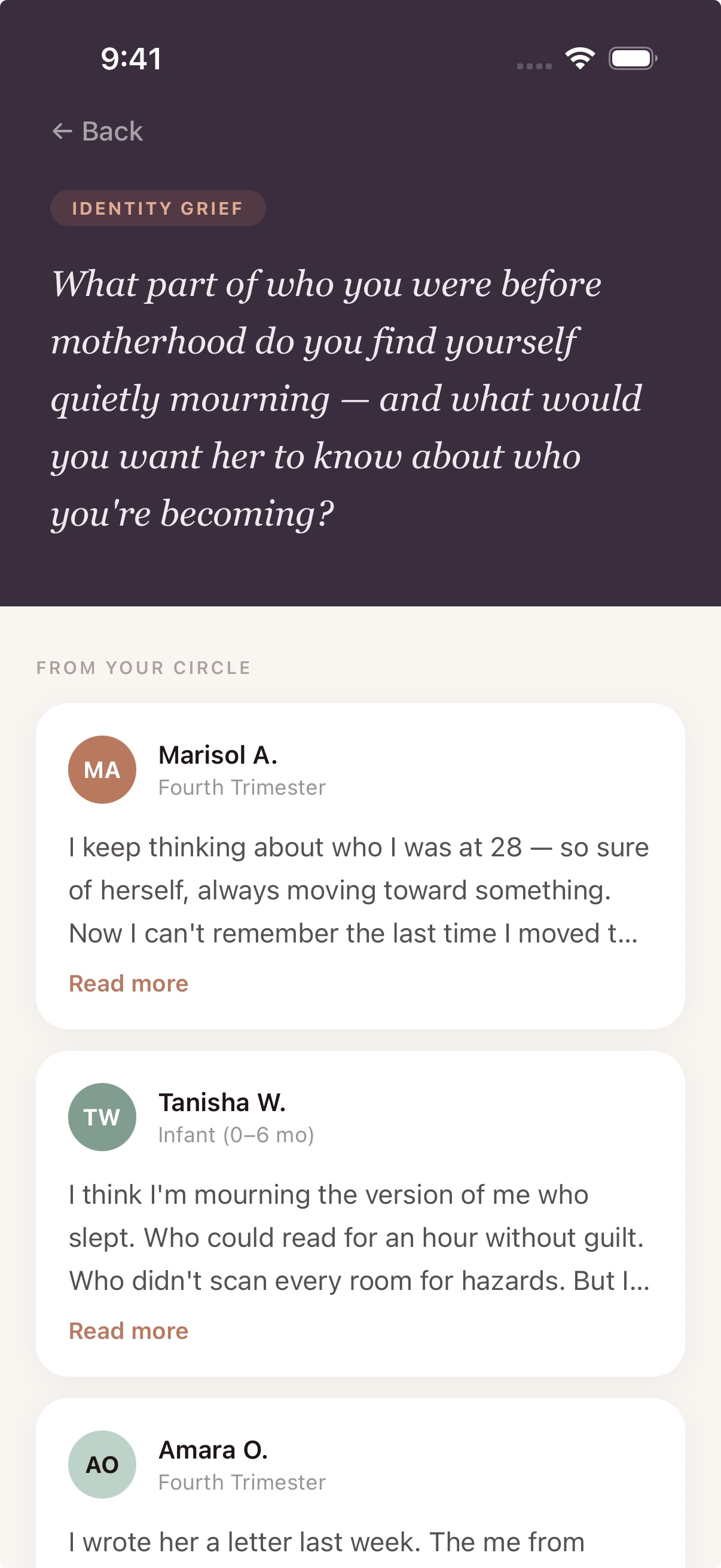
Identity grief that no one validates

Missing who you were before. Grieving your former sense of self — and then feeling guilty for grieving it. This is one of the most common and least talked-about parts of becoming a mother.

🪞
Not recognizing yourself

Looking in the mirror and seeing someone unfamiliar. Your priorities, your relationships, your sense of what matters — all shifting at the same time, faster than you can track.

💬
Feeling like you can't say this out loud

The pressure to only express joy. The silence around ambivalence — loving your child completely and still feeling lost, frustrated, or erased. Liminal is built for the thing you can't say anywhere else.

🔗
Your cultural identity, now in tension

The motherhood you inherited from your own mother, your grandmother, your community — and the mother you're choosing to be. Navigating what you carry and what you're leaving behind.

Emotions that surprise you

Postpartum rage. Unexpected grief. Joy that feels too big. Emotions that don't match what you were told to expect — and no language or framework to make sense of them.

🌱
Something new emerging

Alongside everything hard: a clearer sense of what matters, what you won't tolerate, who you want to become. Matrescence isn't only loss. It's also the beginning of something.

Four ways to come
back to yourself

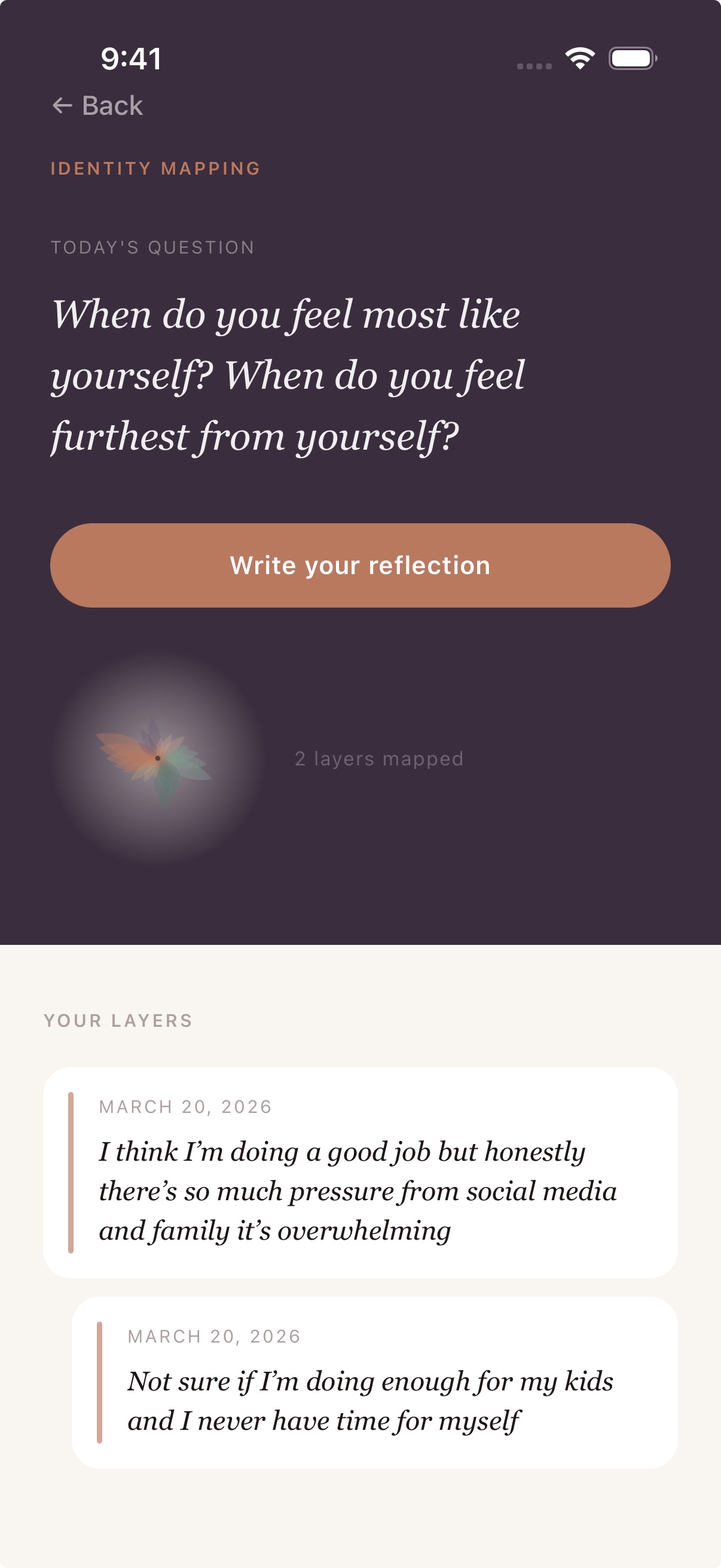
Identity Mapping

"Who am I becoming?"

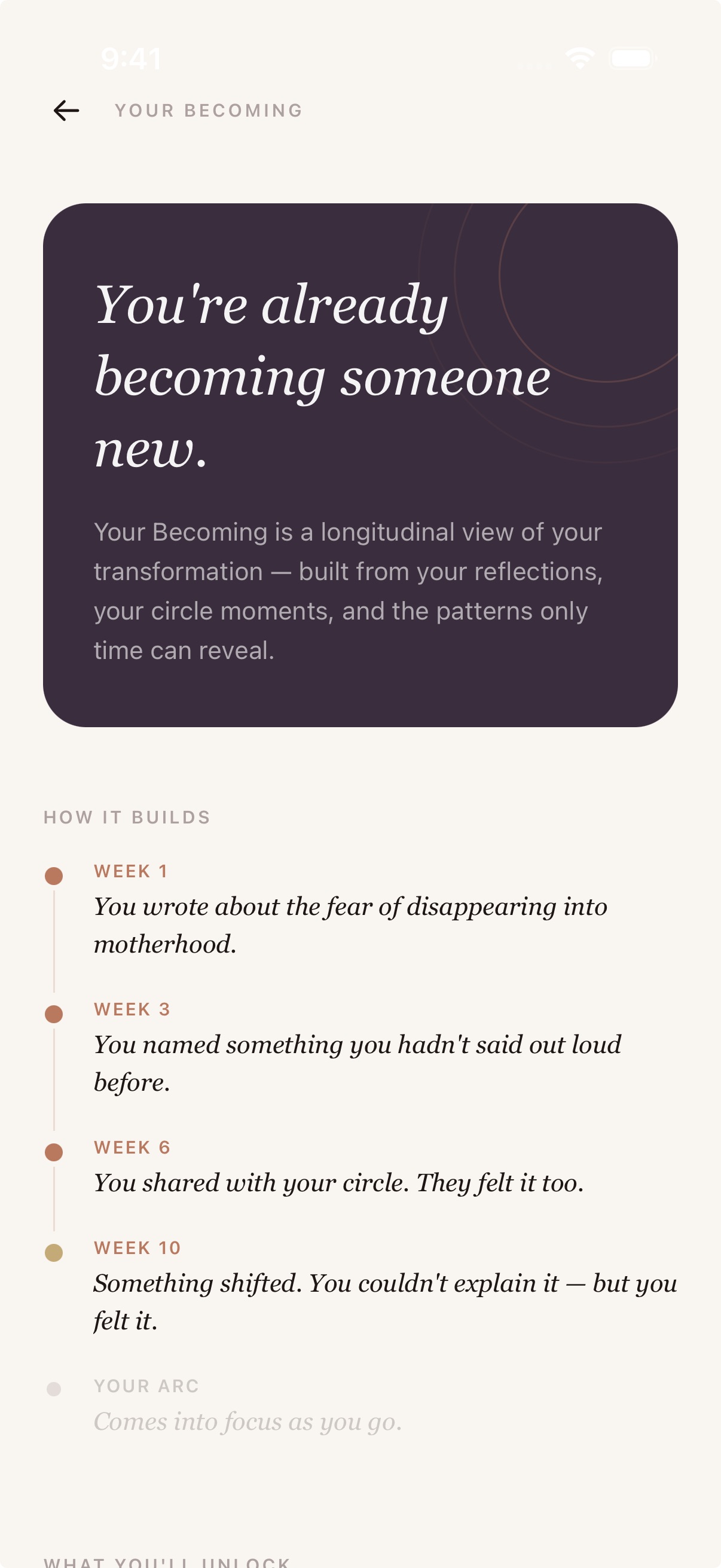
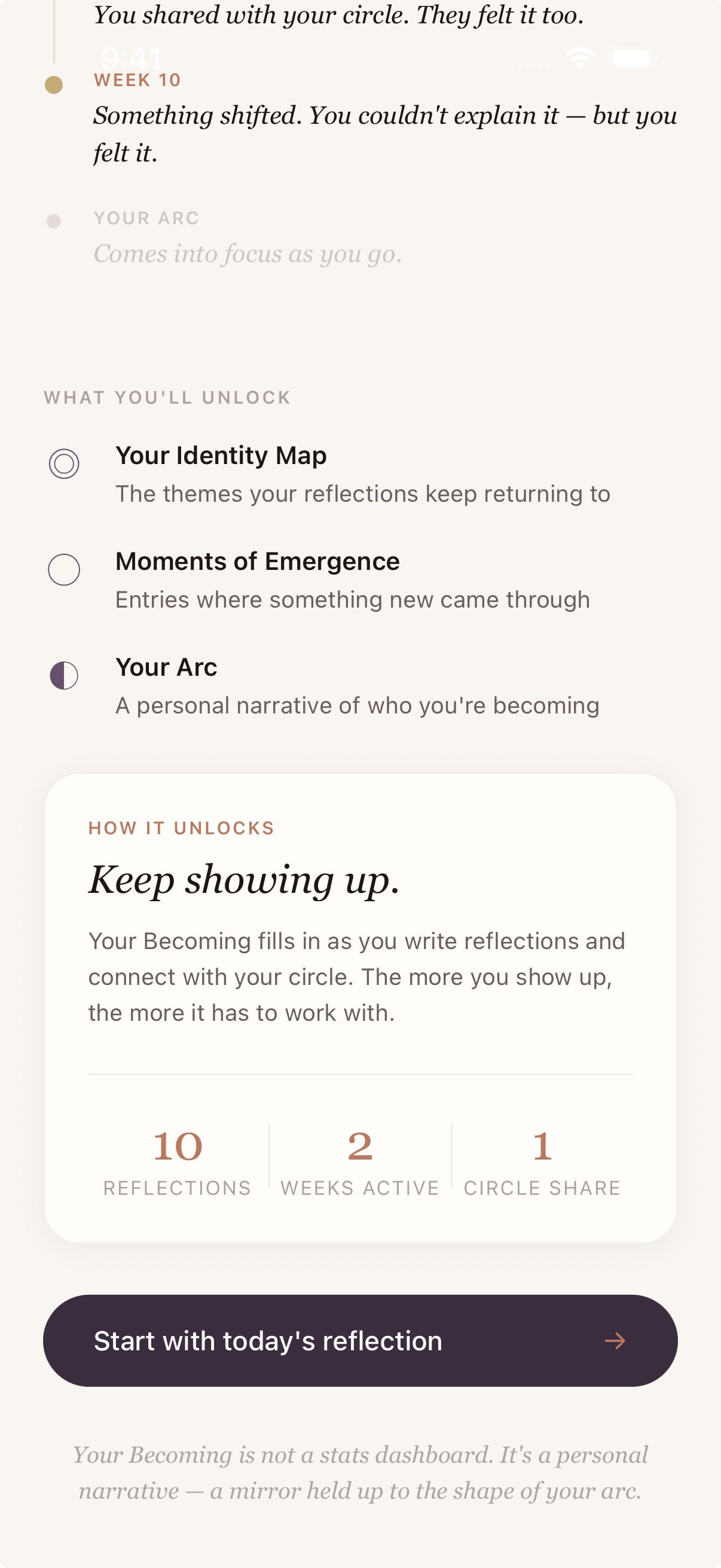
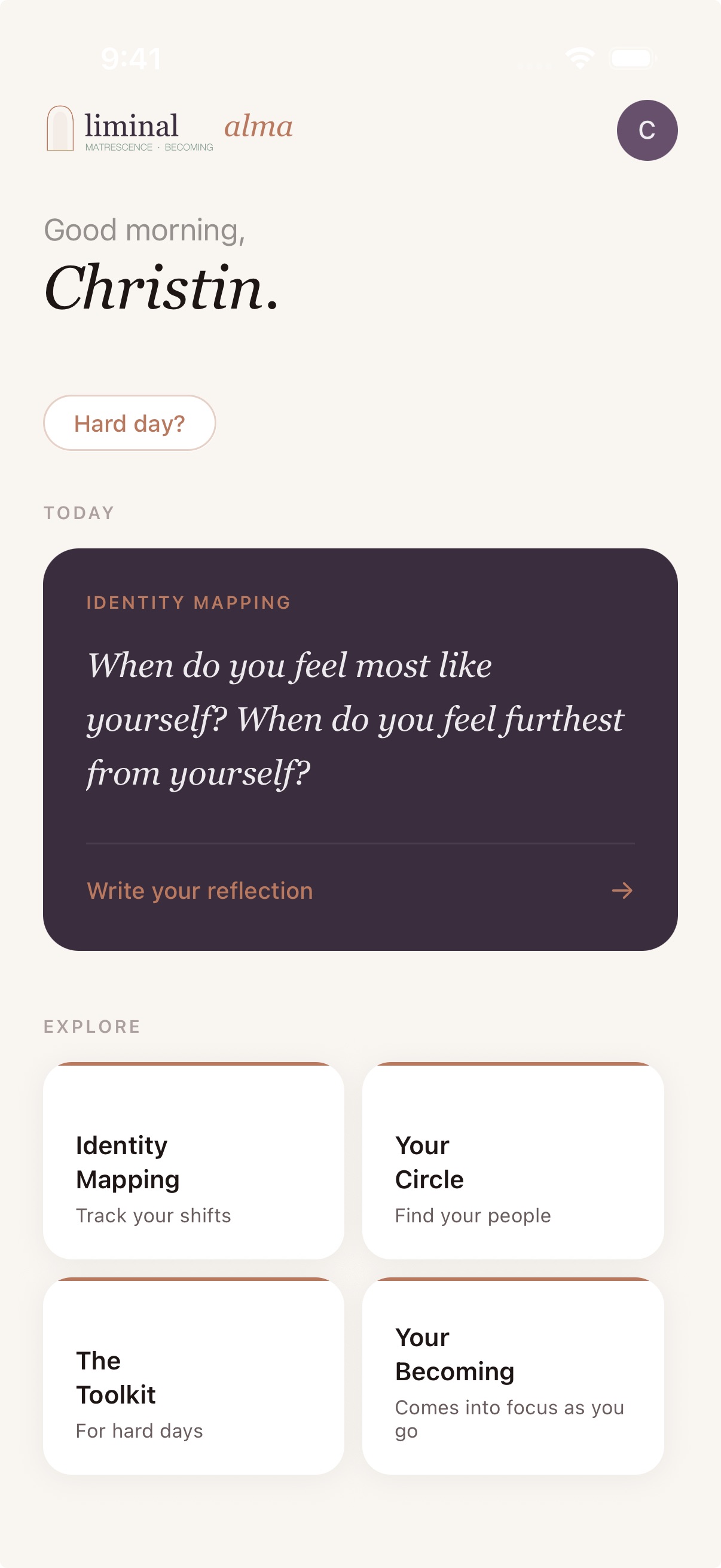
Not journaling for the sake of journaling — but structured reflection tools designed around the specific terrain of matrescence. You track your identity shifts over time. You make meaning of what's happening to you.

  • Daily and weekly prompts grounded in matrescence theory — anchored in self-concept, values, role shifts, and grief
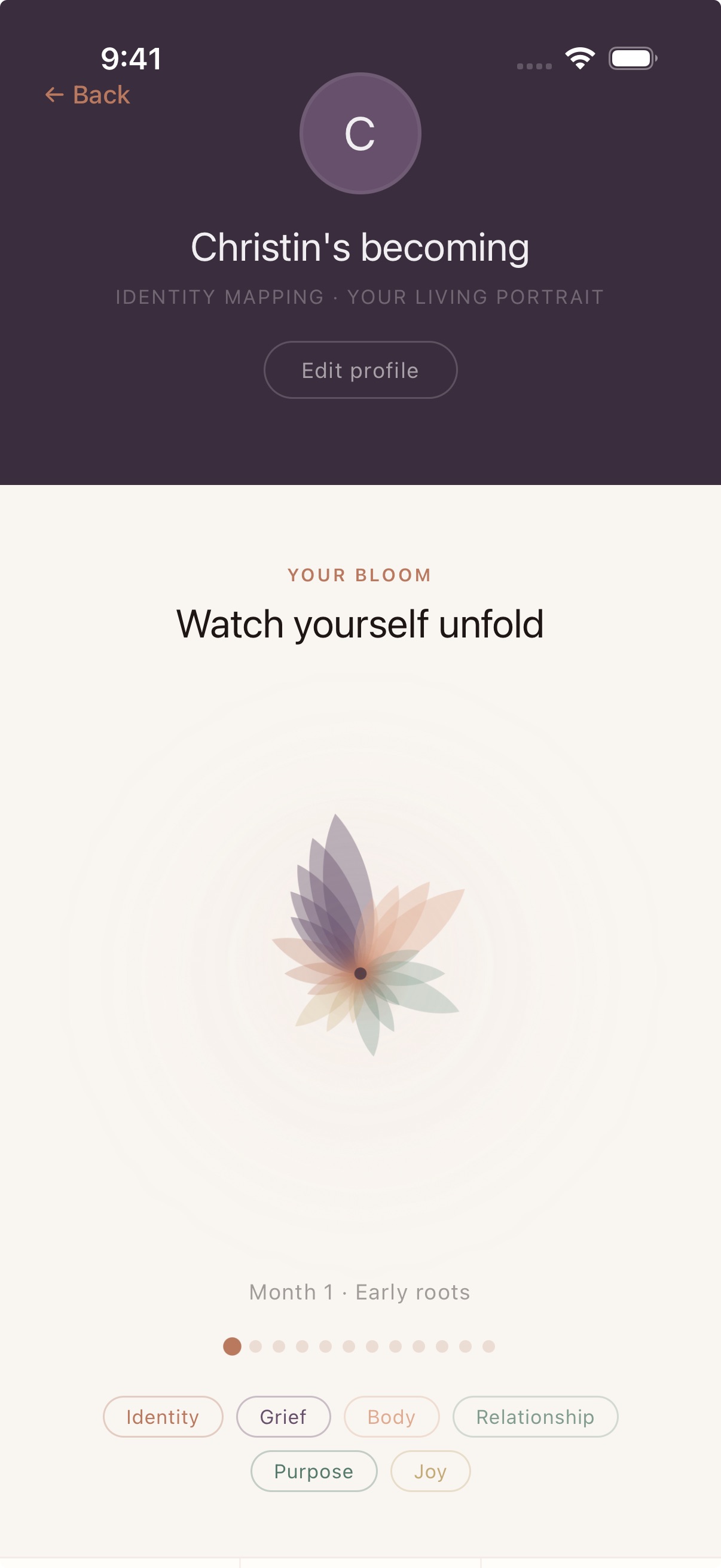
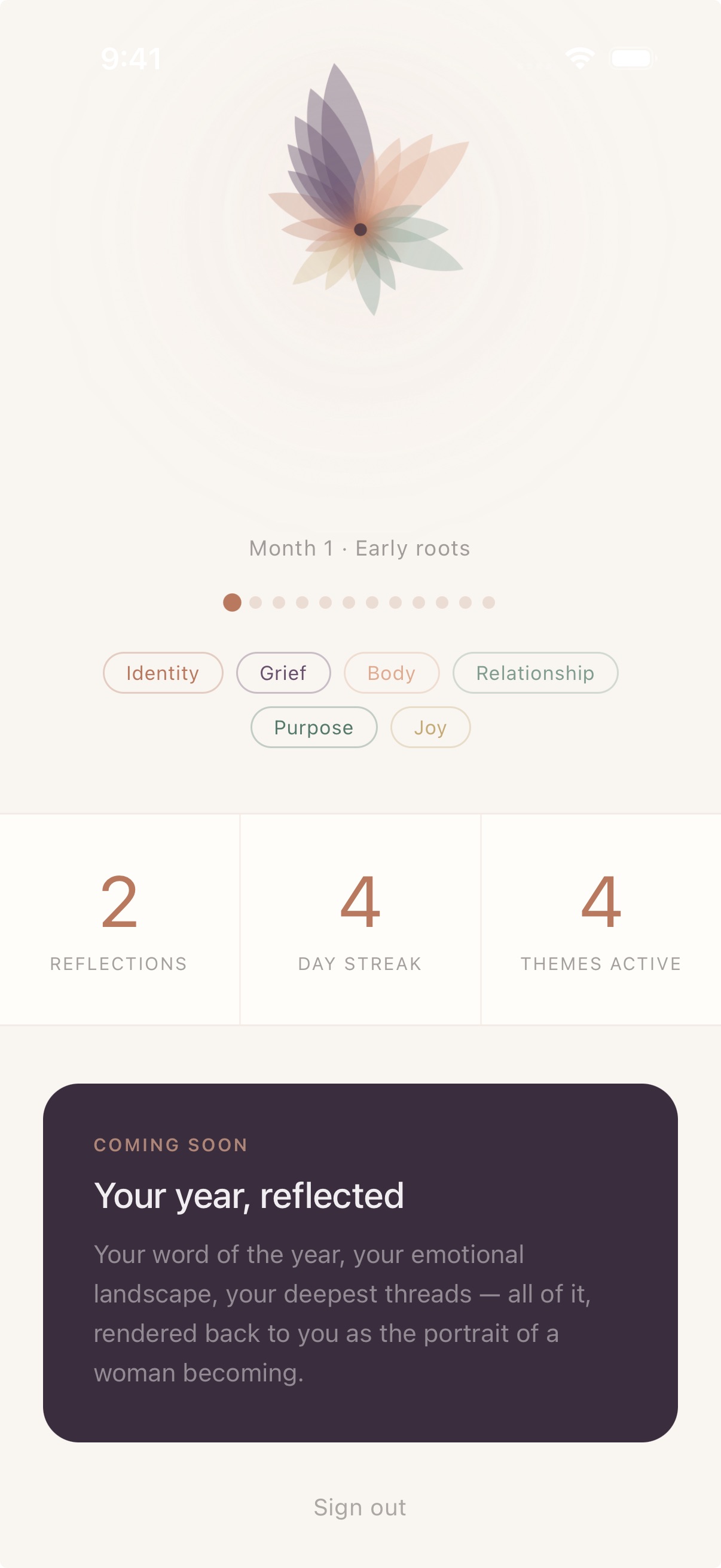
  • A visual identity timeline that evolves as you add entries — watch your matrescence unfold over months
  • Cultural identity prompts that honor what you carry from the women who came before you
  • Ambivalence-safe framing — loving your child and grieving your former self can coexist here
  • Voice memo option for entries — for when you process out loud, not in writing
Today's Reflection
Who are you today?
Prompt
"What part of your old self surprised you this week — by showing up, or by being gone?"
📍 Your Identity Timeline
6 entries this month. Tap to see how you've shifted.
🌱 New prompt unlocked
"What did motherhood look like in the women who raised you?"
🪞
🔥
🧰
📖

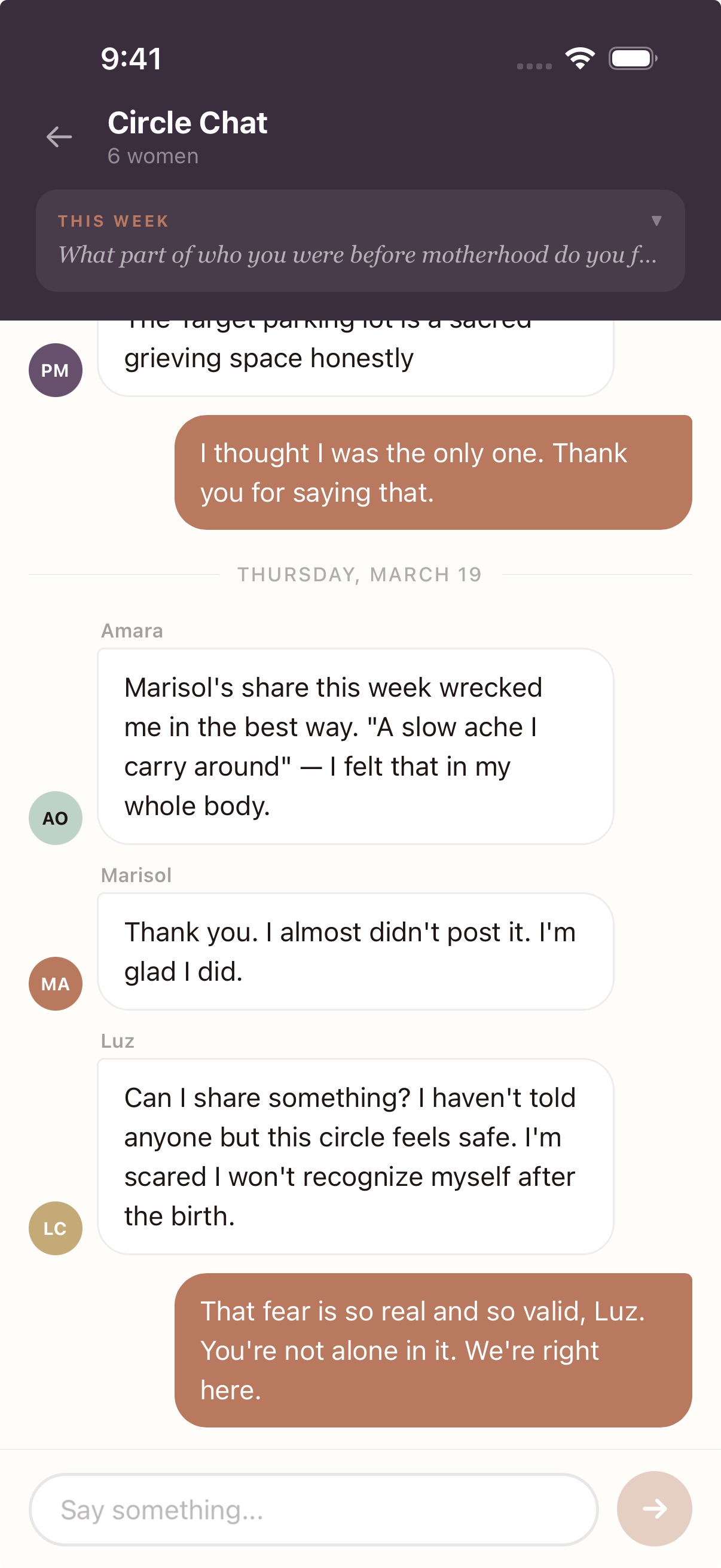
Your Circle

"You are not alone in this."

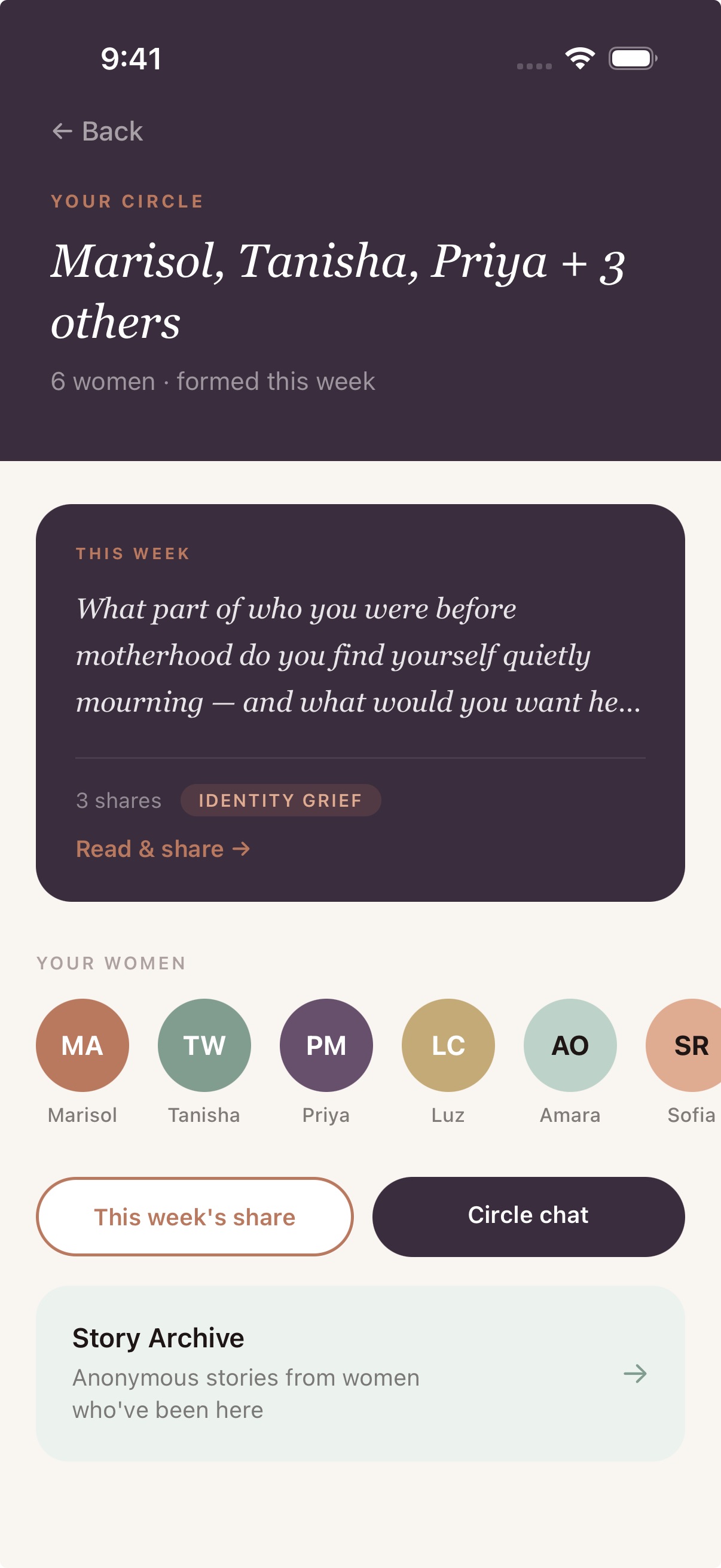
Not a forum. Not a comment section. A curated circle of women matched to you by life stage, background, and lived experience — where story-sharing is structured, intentional, and safe.

  • Circles of 6–10 women, matched by experience: first-generation moms, mothers in recovery, NICU moms, single mothers
  • Facilitated sharing moments with prompts — so no one gets lost, no one gets drowned out
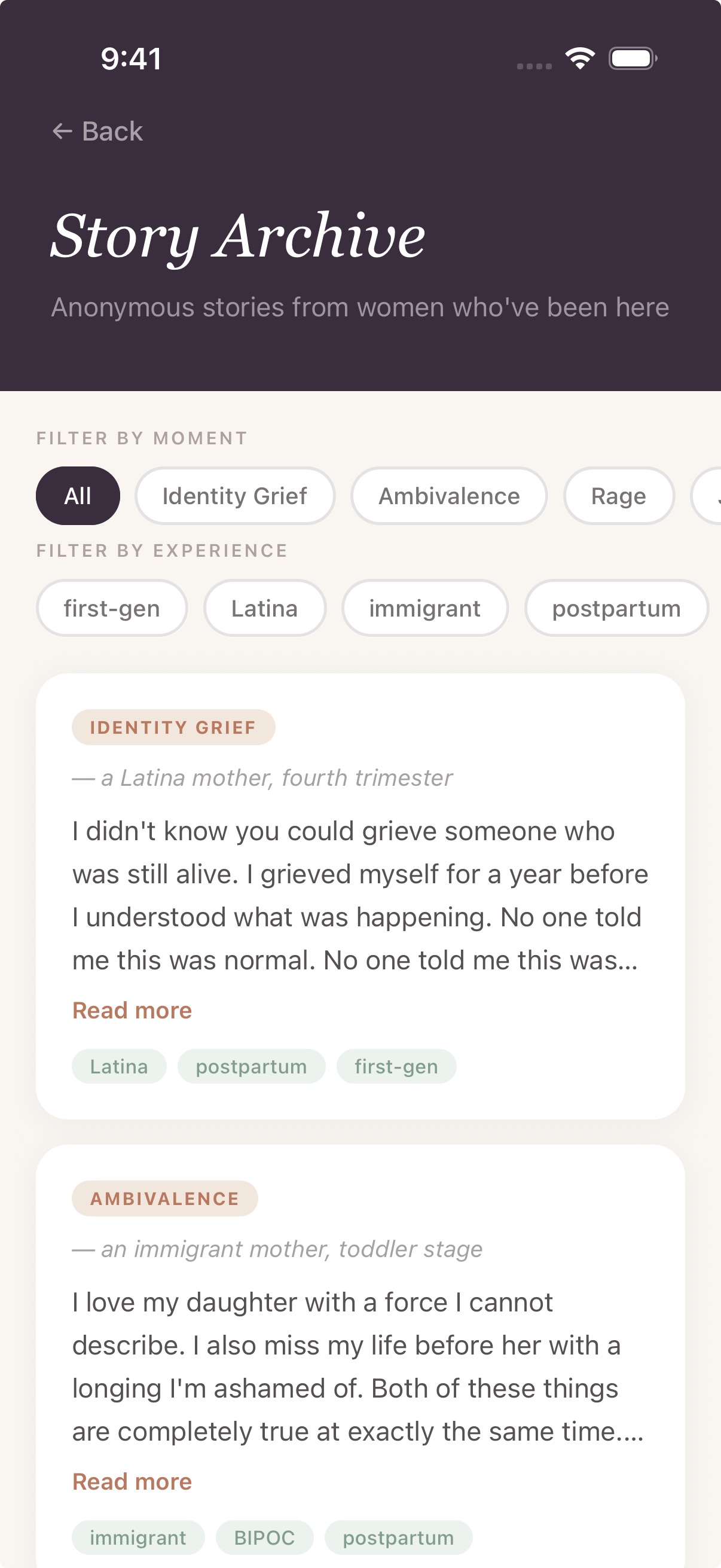
  • Anonymous story archive: real experiences, searchable by identity markers and moment type
  • Available in English and Spanish — written natively in both, not translated
  • Peer facilitators from your community, trained in holding space for this kind of conversation
Your Circle
Your Circle
👩🏽
👩🏾
👩🏿
👩🏻
+4
💬 This week's share
"Something I didn't expect to miss about my pre-mom life..."
📚 Story Archive
34 stories tagged: first-gen · postpartum rage · identity grief
🪞
🔥
🧰
📖

The Toolkit

"I need something right now."

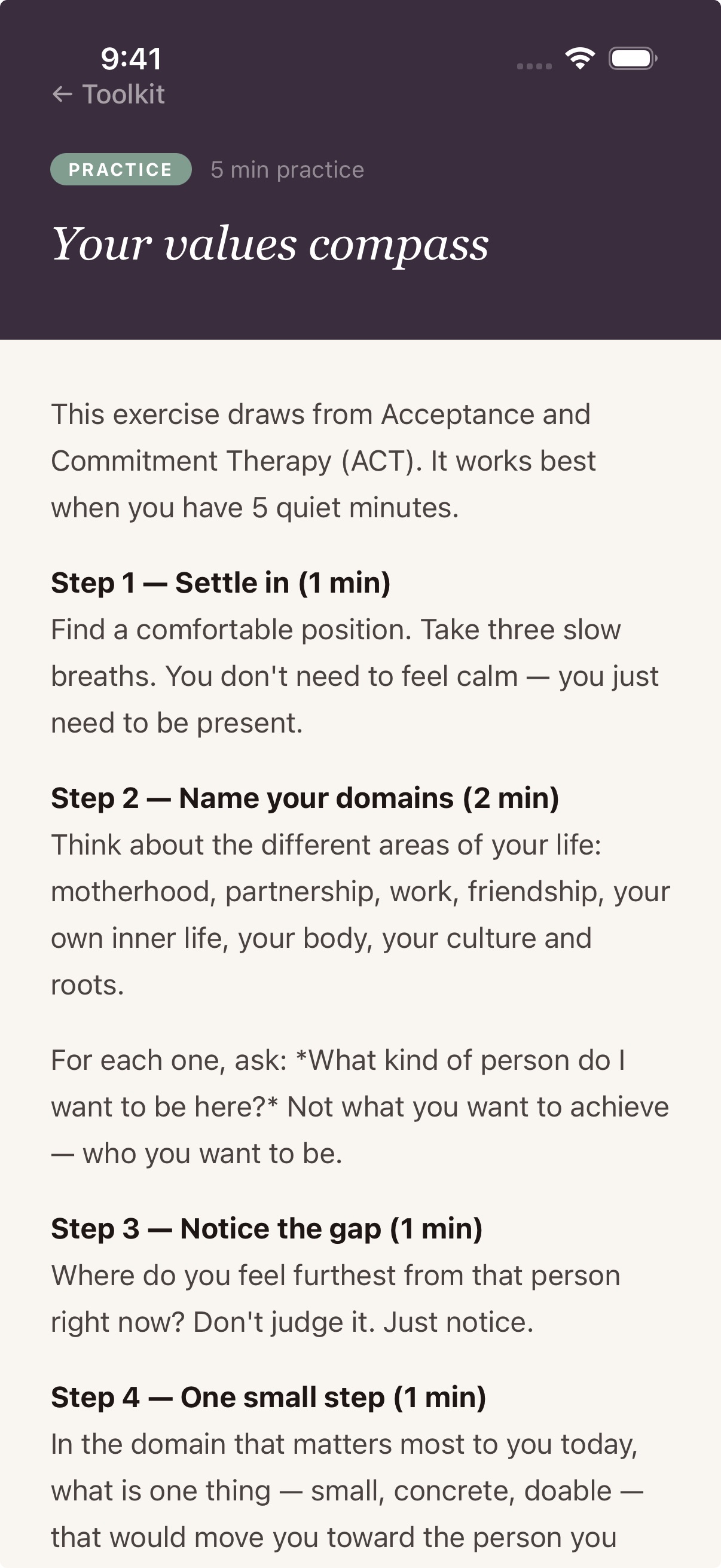
Practical, evidence-based tools organized by what you're actually feeling — not by the baby's age. Filtered by stressor and where you are in matrescence, so what you see is relevant to right now.

  • Browse by stressor: postpartum rage, identity grief, isolation, setting boundaries, navigating family pressure, and more
  • Resources adapt to your child's age stage — what you need at 6 weeks is different from what you need at 18 months
  • "Hard day" fast lane — skip everything, go straight to what helps
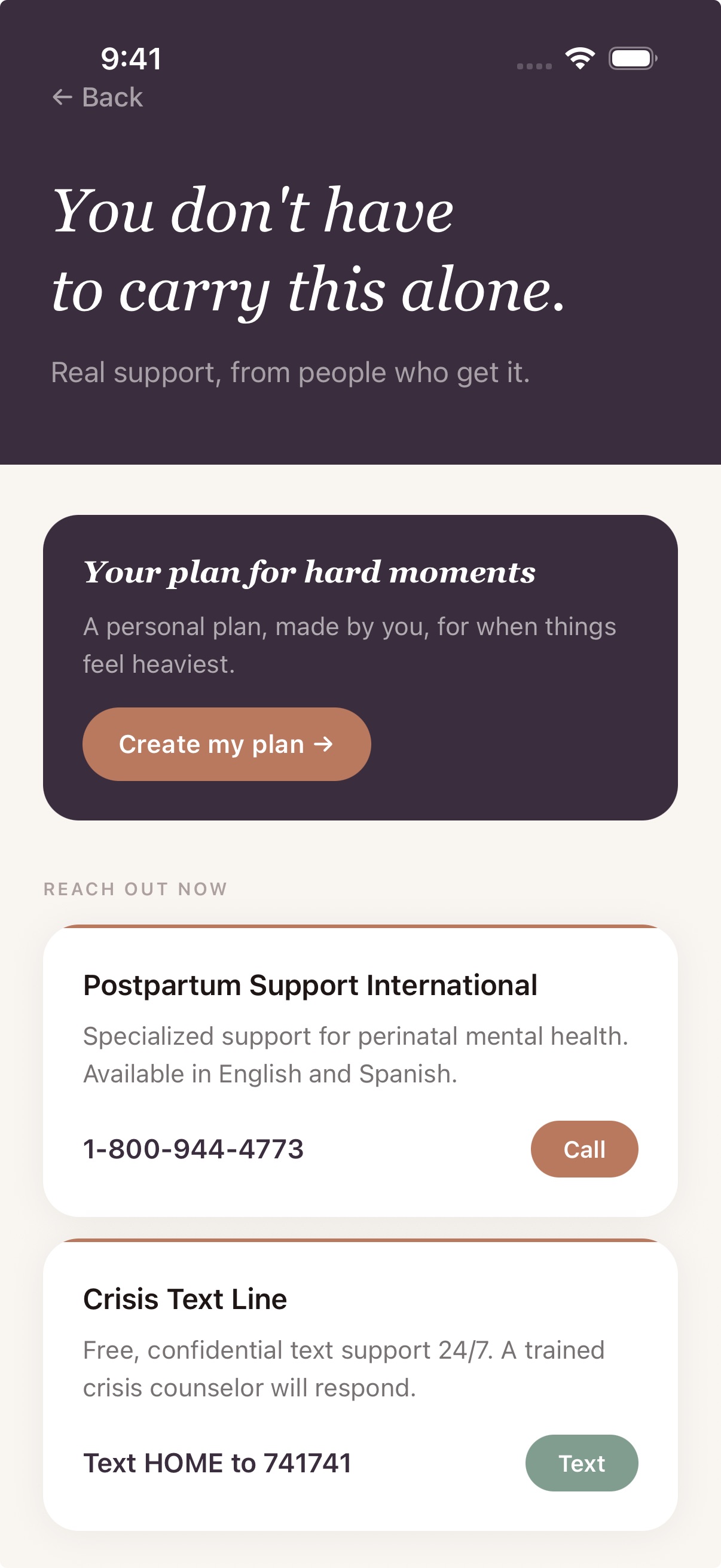
  • Crisis support and safety resources, always one tap away — because some moments need more than a micro-tool
  • Fully bilingual — Spanish tools written natively, not translated
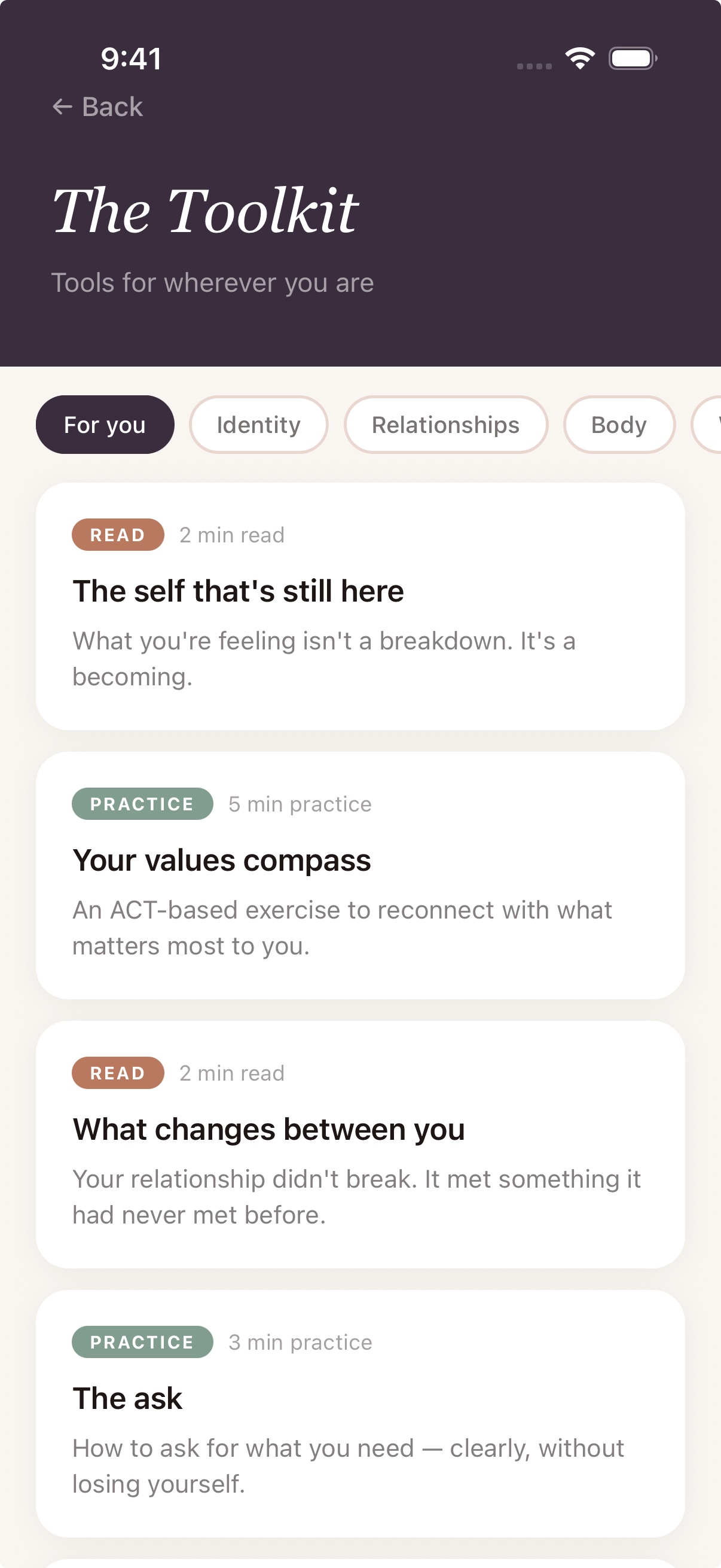
Hard day? Start here.
The Toolkit
🌬 3-min grounding (right now)
🗣 Responding to unsolicited advice
📝 Identity grief — what to do with it
📍 Mother milestone
"Going back to work — identity, not just logistics"
🪞
🔥
🧰
📖

The Framework

"There's a name for what you're feeling."

Psychoeducation that actually meets you where you are. Short, readable content that gives you language for your experience — grounded in real research, written in plain language.

  • Plain-language explanations of matrescence, identity foreclosure, ambivalence, and invisible labor
  • The PERI Model of Radical Healing — a named framework for the journey you're already on
  • "Myth vs. Reality" series: the selfless mother myth, the bounce-back body myth, the natural instinct myth
  • An intersectional lens throughout — how race, class, immigration status, and trauma shape matrescence differently
  • Content developed with community members, not just written for them
The PERI Model
Learn your story
📖 What is matrescence? There's a word for what you're going through.
⚡ Postpartum rage isn't a disorder. Here's what it actually is.
🌿 Radical healing and what it means to reclaim yourself
🧬 Intergenerational trauma + new motherhood
✨ Myth vs. Reality
"A good mother puts herself last." Here's what the research actually says...
🪞
🔥
🧰
📖

Built on a framework
called the PERI Model

Everything in Liminal — every prompt, every tool, every community feature — is organized around a real psychological framework. The PERI Model of Radical Healing reframes perinatal mental health not as the absence of symptoms, but as a process of reclaiming identity, dignity, and collective care.

P
Practice
Rooted in what you carry

Your ancestral knowledge, cultural rituals, and community practices are not separate from your healing — they are central to it. Practice honors what was passed down to you, and creates space to decide what you want to pass forward.

E
Emancipation
Free from the story you were handed

Liberation from the narratives that locate your distress solely within you — the selfless mother myth, the bounce-back expectation, the silence around ambivalence. Emancipation means reclaiming wholeness and self-determination on your own terms.

R
Resistance
Held by others who understand

You are not meant to heal alone. Resistance is the collective power of solidarity — peer support, shared stories, and community spaces where you can speak freely about your experience without being reduced to a symptom or a statistic.

I
Intergenerational Hope
Healing that reaches beyond you

The care you give yourself in this threshold moment echoes forward. Intergenerational hope is the belief — grounded in ancestral wisdom and cultural continuity — that healing, safety, and flourishing are possible for you, your children, and the generations that follow.

C
Christin A. Mujica, Ph.D.
Postdoctoral Fellow, Medical University of South Carolina
NIDA T32 Fellow · Clinical Psychologist
Latina Mother of a 3-year-old Perinatal mental health Liberation psychology Bilingual (EN/ES) PERI Model co-creator

Built by someone
living it and studying it

Dr. Christin Mujica is a Latina clinical psychologist, a postdoctoral fellow at the Medical University of South Carolina — and a mother to a three-year-old. She didn't come to this work from the outside. She is inside it, navigating her own matrescence while building the tools she wished had existed when it began.

That dual vantage point is what makes Liminal different. The research is real. The lived experience is real. And neither one is more important than the other. Dr. Mujica has spent her career working with Latinx communities and populations underserved by mainstream mental health systems — and she is one of the women this app was built for.

She is the co-creator of the PERI Model of Radical Healing, has published research across the American Journal of Psychiatry, American Psychologist, and Harvard Review of Psychiatry, and is fluent in both English and Spanish. Every part of Liminal carries the weight of her work — and the honesty of her own becoming.

What it feels like
to use Liminal

1
The first question isn't about the baby
Liminal opens with a single question about your own experience — not the baby's age, not a feeding schedule. The first thing you do here is be asked how you are. Language selection happens here too, not as an afterthought.
Getting started
2
A check-in, not a screening
A brief narrative-style check-in that asks about your identity, not your symptoms. Not scored, not diagnosed — just a way for Liminal to understand you, so what you see first is actually relevant to where you are.
Personalization
3
A home screen that starts with you
Every time you open Liminal, you're greeted by name and offered a daily reflection prompt — in your language, for where you are. Not a feed. Not a to-do list. Just one question, chosen to be worth sitting with.
Daily practice
4
Your circle, when you're ready
After two weeks of solo use, you're invited to join a circle. Matched by identity, language, and what you've shared. Not a passive feed — a real, intentional commitment to a small group of women going through something similar.
Community
5
Your milestones, not the baby's
Liminal surfaces your milestones proactively — "many women at 4 months postpartum start to experience identity grief as the newborn-phase adrenaline fades." You're not blindsided. You're informed, before it hits.
Always there

Be the first to know
when Liminal launches

We're building this carefully, with the women it's for. Join the waitlist to get early access, share your experience, and help shape what Liminal becomes.

No spam. Just a note when we're ready for you.